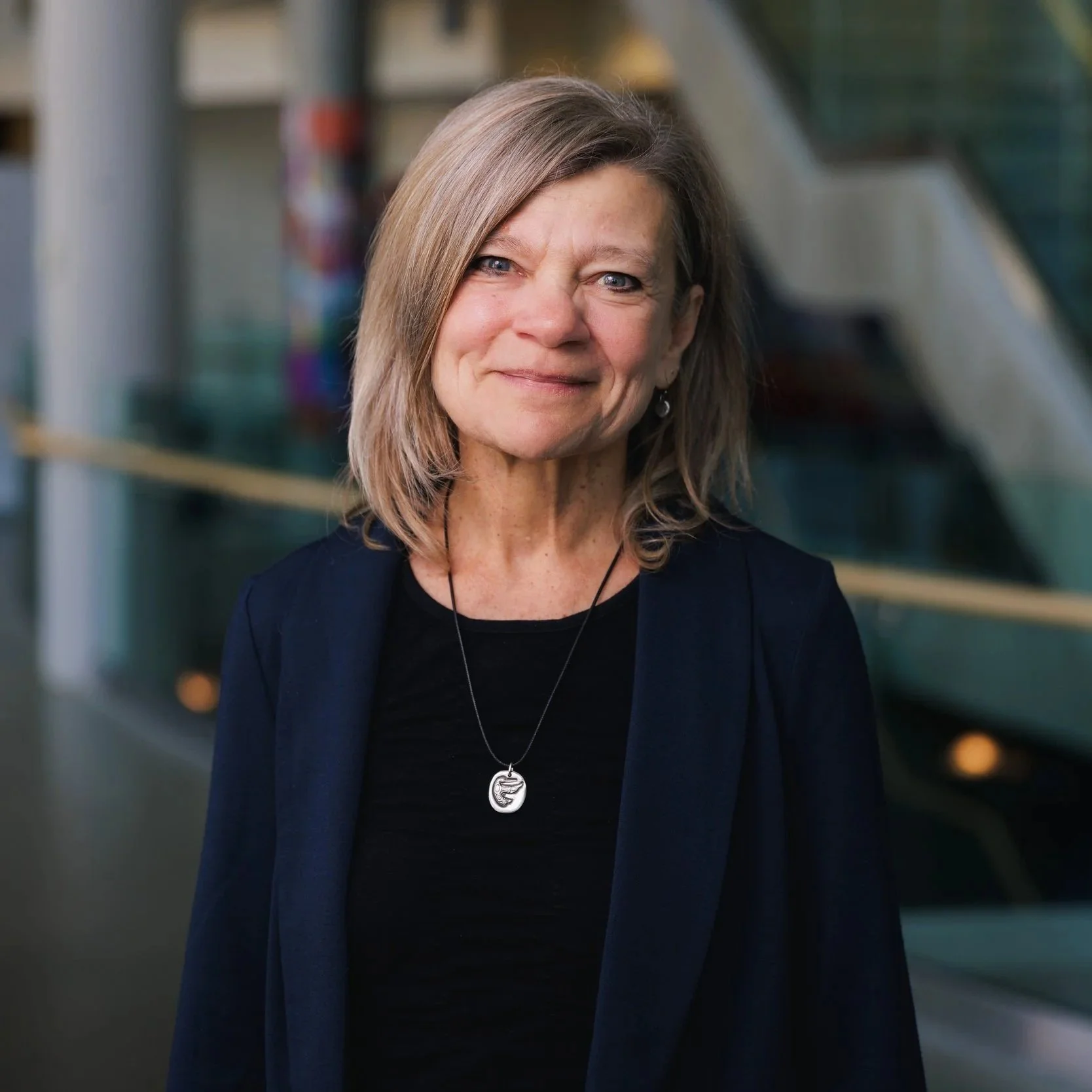
Dr. Ardelle Ries | Principal Investigator
As a white, cis woman of Austrian, Dutch and German ancestry born and raised in the province of Alberta, Canada, I have worked as a professor of music at the University of Alberta (UofA) for 22 years. I am entering the final phase of my post-secondary teaching career — a career dedicated to singing advocacy through songbased music education practices.
My fascination with singing voices is deeply rooted in my family of origin – the vibrant musical environment created by my mother, the poetry recitations of my paternal grandfather, and the countless family sing-alongs that happened on a weekly basis throughout my childhood and adolescence. My undergraduate musical experiences led me to fall yet more deeply in love with the “phenomenon” of the singing voice.
My professional “learning” career and love affair with the voices of children truly began in 1985 as a music specialist for elementary, middle, and secondary school students in an urban elementary school.
The voices of these children kindled a desire to learn more and to be the best teacher that I could possibly be, prompting me to travel to Hungary to pursue graduate work in music education. Thinking that I would only study in Hungary for one year, the voices of Hungarian children beckoned. Between 1991 and 1994, I accepted a teaching mentorship position at the secondary school level in a renowned music conservatory within a specialized Kodály school in Kecskemét, Hungary. Throughout these early career experiences in both Canada and in Europe, my musical and pedagogical journey was profoundly enriched by my work as a professional choral singer.
Upon my return to Canada in 1994, I assumed an administrative role as artistic director of a well-established community conservatory children's choral program, leading a large family of children’s and youth choirs and, as well, learning from a stellar group of bright and deeply inspirational young minds and voices drawn from my choirs and my private vocal studio. It was at this fertile time that I chose to continue to pursue graduate studies in voice and choral conducting at the University of Alberta.
Over the last four decades, my understanding of children, children’s voices and related pedagogical practices have evolved significantly. My identity as a music educator was heavily influenced by the tenets of Hungarian composer, ethnomusicologist, linguist, composer and philosopher, Zoltán Kodály, whereby I strictly adhered to his pedagogical philosophy that “only the best is good enough for children” (Kodály in Bonis, 1974). For the first twenty years of my career, this adage was the signature of my approach to teaching, profoundly shaping the manner in which I taught, the repertoire I chose, and what I thought to be the desired sound “ideal” for children’s choirs and the “proper” way for children to sing. My work was laser focused on traditional “treatment” of the child singing voice with the primary objective of developing the upper vocal register — the purported “head” voice.
My dissertation exploration of children, childhood and the enculturation/acculturation of the child singing voice from physiological, pedagogical and sociological perspectives, eventually led me to reconsider these deeply ingrained pedagogical beliefs and praxis, challenging my view of the “child voice” as a literal object in need of “taming” or “training.” (Ries 2004). At that halfway point in my career I was called to release my own pedagogical agenda, step back, and listen carefully to the children, their speech and their song, and to accept their natural abilities to teach us all, well beyond the limits of what is considered to be the “best,” the “good,” the “right,” and the “proper.”
As childhood is a construct, vulnerable to societal fluctuation and change, it is a precious, temporal place that can never be revisited. There is much to be learned from those who inhabit that ever-changing world. It is from this perspective that FVC research has been conducted. Our team has reflexively taken steps to better understand and listen to the “authentic” voices of children providing a venue for FVC research participants to be respected, honoured and celebrated as legitimate collaborators.
Whether we are children or adults, the SARS-CoV-19 pandemic has now transported us to a land dependent on technology to the extreme, adding yet another question to our pandemic-related investigations. Will this electronically dominated environment continue to draw children away from the wonders of their unmediated singing voices and the freedom of expression through singing? It is our hope that FVC research will provide insight and prompt others to make space for deep listening and transformational learning through joyful singing.